DJI Air 3S vs Mini 4 Pro
Which drone suits paid shoots on the Durban coast? Both compared.
Air 3S and Mini 4 Pro side by side
Figures are DJI’s published specifications. Flight times are maximums in still air, so plan for less. When your paperwork is in order, you can hire our DJI Air 3S in Durban.
- Main camera
- Air 3S: 1-inch sensor, 50MP. Mini 4 Pro: 1/1.3-inch sensor, 48MP.
- Second camera
- Air 3S: 48MP 3x telephoto on a 1/1.3-inch sensor. Mini 4 Pro: none.
- Slow motion
- Air 3S: 4K at 120fps. Mini 4 Pro: 4K at 100fps.
- Colour
- Both record 10-bit D-Log M for grading.
- Flight time
- Air 3S: up to 45 minutes. Mini 4 Pro: up to 34 minutes on the standard battery.
- Wind resistance
- Air 3S: 12 m/s. Mini 4 Pro: 10.7 m/s.
- Weight
- Air 3S: 724 g. Mini 4 Pro: under 249 g.
- Obstacle sensing
- Both sense in all directions. The Air 3S adds forward-facing LiDAR for low light.
- Internal storage
- Air 3S: 42 GB. Mini 4 Pro: 2 GB.
What the differences mean on a shoot
Specifications matter when they change the footage you take home.
Low light
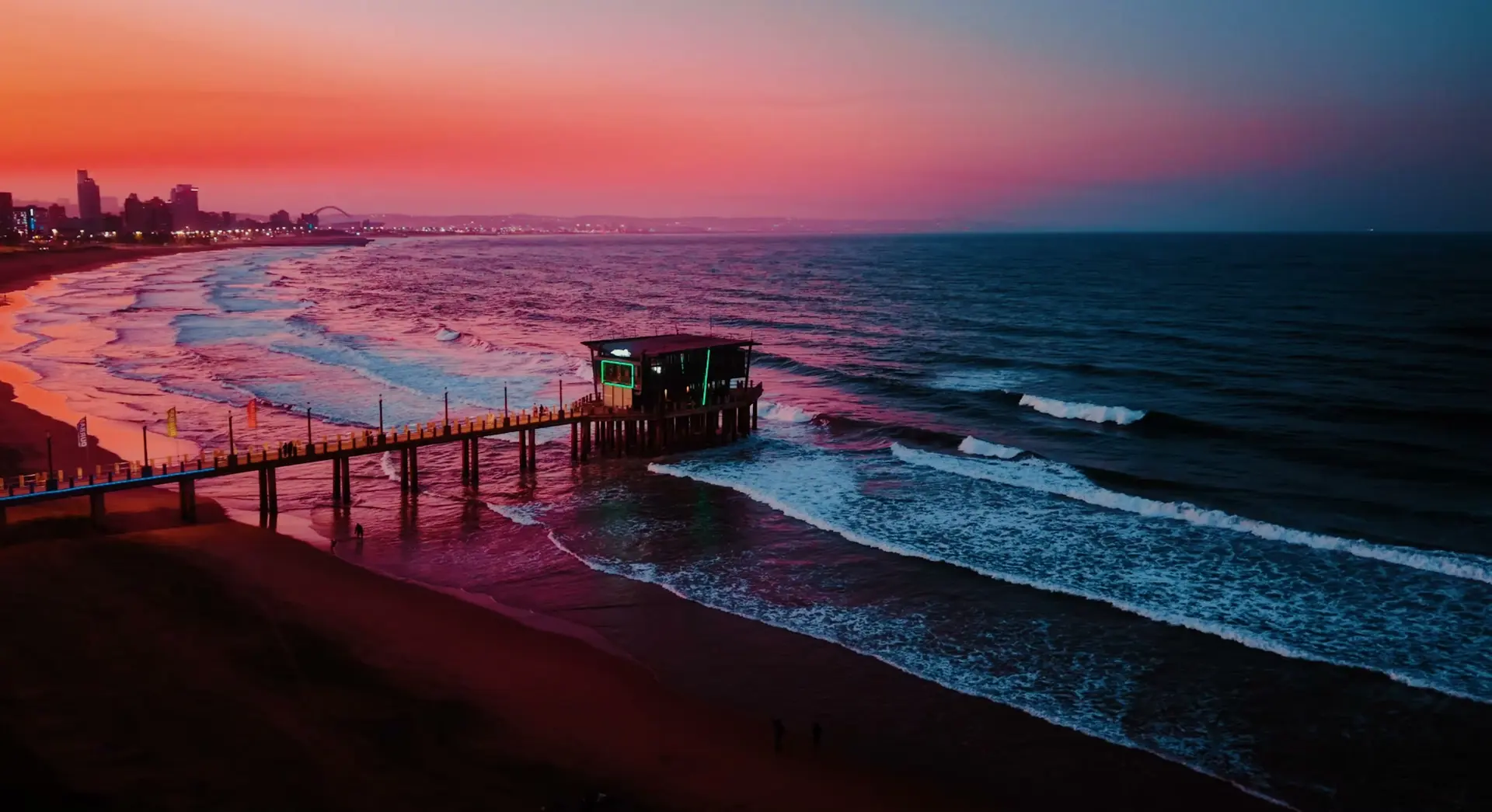
The 1-inch sensor gathers more light, so dusk shots over the beachfront hold more detail and less noise.
Framing
The 3x telephoto compresses the background and lets you keep distance from people, roads and buildings.
Wind
A heavier drone with a higher wind rating holds its position better in the sea breeze.
Does the lighter drone avoid the rules?
In some countries a drone under 250 g escapes parts of the law. South Africa is different.
- Part 101 applies
- The regulations cover drones of every size, so a 249 g drone follows the same flying rules.
- Distances
- Stay 50 m from people, public roads and property without permission, whatever the drone weighs.
- Airports
- Stay 10 km from airports, airfields and helipads unless you have approval.
- Paid work
- Commercial flights need a licensed pilot and an approved operator with either drone.
Which one should you choose?
Both are good drones. The right one depends on the job.
Choose the Air 3S
For client work, property, events, film and inspections, where image quality, zoom and flight time earn their keep.
Choose the Mini 4 Pro
For travel and casual flying, where a small bag and a lower price matter more than a second camera.
Hire before you buy
A 2 hour hire of the Air 3S costs R4,000 excl. VAT, a low-risk way to test it on a real shoot.
Which drone for which job
Choose the Air 3S for client work where image quality, zoom, flight time and wind resistance matter, and the Mini 4 Pro where weight and price matter most.
| Job | Better fit | Reason |
|---|---|---|
| Property marketing | Air 3S | The larger 1-inch main sensor and the 3x telephoto give you two kinds of shot. |
| Events and weddings | Air 3S | Flight time of up to 45 minutes per battery, and the telephoto keeps you back from people. |
| Construction progress | Air 3S | Telephoto detail from a distance, plus stronger wind resistance. |
| Windy beachfront | Air 3S | The Air 3S is rated to 12 m/s and has stronger wind resistance. |
| Travel and casual flying | Mini 4 Pro | It weighs under 249 g and costs less. |
| Small bag, simple kit | Mini 4 Pro | One camera and a lighter weight. |
Questions to ask before you buy either drone
Answer five questions about your work first, because they settle the choice faster than a specification sheet.
- Is the flying paid?
- Weight does not change the SACAA rules for paid work, so budget for the registration, pilot licence and operator paperwork whichever drone you choose.
- Do you need a second camera?
- If a shoot calls for both a wide scene and a close detail, the Air 3S has the telephoto and the Mini 4 Pro does not.
- How windy are your locations?
- Coastal sites with sea breeze favour the Air 3S, which has the stronger wind resistance.
- How long is each flight?
- A maximum flight time of up to 45 minutes means fewer battery swaps on the Air 3S.
- How much do you carry?
- The Mini 4 Pro weighs under 249 g and fits a travel bag more easily.
A two hour trial before you commit
Hire the Air 3S for the 2 hour minimum, R4,000 excl. VAT or R4,600 incl. VAT, and test your own shot list before you spend on a drone.
- Write a shot list from the work you really do, such as a property, a site or an event.
- Book the 2 hour minimum and send your documents on the application form.
- Fly the wide camera and the 3x telephoto on the same subject and compare the results.
- Test the drone in the wind you normally work in, with a safe reserve on the battery.
- Edit the footage as you would for a client, and judge whether the Air 3S or a lighter drone fits your work.
- Return the kit on time, and your R5,000 deposit comes back within 7 business days of a satisfactory return.
We hire out only the Air 3S, so this trial covers the Air 3S and not the Mini 4 Pro. Drone hire prices in Durban
DJI's own figures side by side
On DJI's published figures the Air 3S leads on flight time and main camera resolution, the Mini 4 Pro weighs about a third as much, and both list the same 10 km video range.
- Flight time
- The 11 minute gap on standard batteries is about a quarter of an Air 3S flight. Across three batteries, that is up to 33 more minutes in the air on DJI's figures.
- Weight
- 724 g against under 249 g. The lighter drone packs smaller and travels more easily, and the heavier one carries the higher wind rating, as the section below shows.
- Resolution
- 50MP against 48MP is a small gap on paper. The sensor behind it, 1-inch against 1/1.3-inch, is the larger physical difference.
- Range
- DJI lists 10 km under CE rules for both. You still keep the drone within your line of sight.
Aperture and focal length sit closer together. DJI lists the Mini 4 Pro's camera at f/1.7 against f/1.8 on the Air 3S wide camera, so the Mini's aperture is slightly wider, and both main cameras sit at 24 mm equivalent. The Air 3S main camera has the larger sensor, 1-inch against 1/1.3-inch.
The Plus battery trade-off on the Mini 4 Pro
DJI lists the Mini 4 Pro at 45 minutes only with the heavier Intelligent Flight Battery Plus, and its under 249 g takeoff weight applies to the standard battery.
- If weight is your reason
- Fly the standard battery and accept up to 34 minutes. DJI's under 249 g figure applies to that set-up.
- If flight time is your reason
- The Battery Plus matches the Air 3S at 45 minutes, but it is heavier, so read what DJI lists for that set-up before you buy.
- If you need both cameras
- No battery adds a telephoto. The Mini 4 Pro has one camera with either battery.
- If you fly for a client
- Our reading of SACAA's public page is that the purpose of the flight sets the paperwork, so the battery choice does not change it. Check with SACAA.
If you want long flights in a small drone, the Battery Plus is the set-up to price when you buy. If you want to try the larger drone first, the Air 3S is the one we hire out in Durban. With the Battery Plus fitted, DJI lists 45 minutes for both drones, so flight time stops separating them. The second camera, the 1-inch main sensor and the 12 m/s wind rating stay with the Air 3S.
Wind ratings in km/h for the coast
DJI rates the Air 3S to 12 m/s, about 43.2 km/h, and the Mini 4 Pro to 10.7 m/s, about 38.5 km/h, which gives the Air 3S about 4.7 km/h more headroom.
A rating marks the edge of what the drone can hold against. A forecast gives an average wind and gusts can run above it, so set your own working limit well under either figure, and land when the drone starts to drift.
- Read the forecast wind and the gust speed for your exact location, not the nearest city.
- Convert the forecast to the same unit as the rating, using the factor 3.6 between m/s and km/h.
- Hover at a safe height for a short time after take-off and watch for drift.
- Land and wait when gusts climb towards your working limit, whichever drone you fly.
The telephoto matches the Mini's sensor
DJI lists the Air 3S medium telephoto with a 1/1.3-inch 48MP sensor, the same size and resolution as the Mini 4 Pro's only camera, but at 70 mm equivalent instead of 24 mm.
- Same sensor size
- Both cameras use a 1/1.3-inch CMOS sensor at 48MP, on DJI's figures. Only the framing differs.
- Different framing
- At 70 mm the Air 3S frames a subject close to three times tighter than a 24 mm camera from the same spot.
- What the Air 3S adds
- A second camera on top: the 1-inch 50MP wide camera at 24 mm, so one drone covers the wide scene and the tight detail.
- What it means for you
- If you already fly a Mini 4 Pro, the Air 3S telephoto gives you that sensor at a longer focal length, and the wide camera gives you a larger sensor than the one you have.
Air 3S: switch to 70 mm and stay back. Mini 4 Pro: fly closer, which the 50 m distances may not allow near people, roads or property.
Air 3S: orbit wider on the telephoto for a compressed background. Mini 4 Pro: orbit closer on the wide camera.
Both drones shoot this at 24 mm equivalent. The Air 3S records it on the larger 1-inch sensor.
A wide move that both drones fly on their 24 mm cameras.
If most of your work is wide establishing shots, the second camera matters less. If you photograph details on buildings, stages or ships, it saves you flying closer to them.
Use this when you plan a shot list. If a shot needs the subject large in frame and the 50 m distances keep you back from people, roads or property, the Air 3S switches to 70 mm and stays where it is. The Mini 4 Pro has no second camera to switch to.
Slow motion and storage on the day
DJI lists the Air 3S at 4K up to 120fps and Full HD up to 240fps, against 100fps and 200fps on the Mini 4 Pro, with 42 GB of internal storage against 2 GB.
- 4K slow motion
- Played back at the same speed, 120fps footage from the Air 3S runs slower than 100fps footage from the Mini 4 Pro.
- Full HD slow motion
- 240fps against 200fps, for the slowest moments either drone can record.
- 4K or Full HD
- Stay in 4K when you may crop or reframe later, and drop to Full HD only when you need the slowest motion either drone records.
- Storage without a card
- 42 GB on the Air 3S holds a working reserve if a card fills or fails. 2 GB on the Mini 4 Pro is a short emergency buffer.
- Card plan for both
- Bring fast memory cards and copy footage between locations, whichever drone you fly. Label each card with the location and date so nothing is overwritten on a long day.
- Vertical video
- DJI lists 2.7K vertical video on the Air 3S at 1512 x 2688 pixels, up to 60fps. Check DJI's Mini 4 Pro page for its vertical modes before you compare the two for social work.
Rules that apply to both drones
Our reading of SACAA's public page is that the purpose of the flight sets the paperwork, and the airport circles apply in the same way, whether the drone weighs 249 g or 724 g.
| Use, as SACAA's page describes it | What the page lists |
|---|---|
| Private: an individual's personal purposes, with no commercial outcome, interest or gain | R-VLOS only, day and night, with a Class 1A or 1B UAS. No RPL or certificate of registration |
| Commercial, corporate or non-profit | A registered UAS, a Remote Pilot Licence, a UAS Operating Certificate and a UAS Letter of Authority |
| Class 1A or 1B, as the page defines it | Mass under 7 kg and impact energy under 15 kJ |
Both drones weigh far less than 7 kg, but the class also sets an impact energy limit, so confirm where your drone falls with SACAA at rpasInbox@caa.co.za. Drone laws in South Africa
Our reading of SACAA's public page is that you do not fly 10 km or closer to an aerodrome without SACAA approval, and the page states that distance without a weight exemption. The figures are straight-line distances from each airport reference point, and the real boundary sits slightly closer, so check your spot with SACAA. The harbour entrance sits just outside the Virginia circle, but the harbour and port rules apply separately. Where to fly a drone in Durban
Test the Air 3S for the length of a real job
If your real jobs run longer than 2 hours, price a test hire at the length of a real job, so you judge the Air 3S under the same battery and time pressure.
Overnight or Friday? 8 hours can run overnight at the same rate: collect 15:00 to 16:30, return by 10:00 the next working day. On a Friday, or before a public holiday, the kit comes back by 10:00 on the next working day. Each weekend day or public holiday you fly costs R2,000 excl. VAT an hour of flight time, rounded up, with a 2 hour minimum, taken from your deposit at return.
- Hire excl. VAT
- R8,000
- Operator excl. VAT
- R0
- VAT at 15%
- R1,200
- Total incl. VAT
- R9,200
- Refundable deposit
- R5,000
- Paid by EFT before collection
- R14,200
Add your name so the invoice is made out to you.
The estimate is free to keep and compare. The pro forma invoice carries our banking details and a payment reference, so you can pay by EFT straight away. Your details stay in your browser; nothing is sent to us until you contact us.
Rates excl. VAT: R2,000 an hour, 2 hour minimum, R8,000 half day, R16,000 full day. Operator R2,000 an hour excl. VAT, only when free on your date. A full day can run overnight: collect between 15:00 and 16:30 on a weekday and return by 10:00 the next working day, for sunset and sunrise shots. Shorter hires come back the same day. On a Friday, or before a public holiday, the kit comes back by 10:00 on the next working day. Each weekend day or public holiday you fly costs R2,000 excl. VAT an hour of flight time, rounded up, with a 2 hour minimum, taken from your deposit at return. Your invoice is final, apart from flight time on weekend days or public holidays, which we charge at return. The deposit comes back within 7 business days of a satisfactory return.
A half day gives you time to fly all three batteries, move between locations and carry the 724 g drone the way you would on a job. On your own shot list you see how often you reach for the telephoto and whether the higher wind rating changes your day, which tells you more than the specifications above. A half day costs R8,000 excl. VAT, or R9,200 incl. VAT, plus the R5,000 refundable deposit, and the calculator shows any length between 2 and 8 hours.
Frequently asked questions about the Air 3S and Mini 4 Pro
Still unsure? Ask us on WhatsApp or call 031 205 0210.
Is the DJI Air 3S better than the Mini 4 Pro?
For image quality, zoom, flight time and wind handling, yes. The Mini 4 Pro wins on size, weight and price.
Does a drone under 250 g need a licence in South Africa?
Weight does not decide it. Private flying needs no licence with either drone, and commercial flying needs a licensed pilot and an approved operator with both.
Which drone do you hire out in Durban?
We hire out the DJI Air 3S with the RC 2 controller and three batteries, from R2,000 an hour with a 2 hour minimum, excl. VAT.
Can the Mini 4 Pro handle Durban wind?
It is rated to 10.7 m/s, against 12 m/s for the Air 3S. On gusty days near the sea the heavier drone is steadier.
Is the Air 3S harder to fly?
No. Both use the same DJI Fly app and similar controls. We walk you through the drone at handover.
Which drone is better for property marketing?
The Air 3S suits property work because it has the larger 1-inch main sensor and a 3x telephoto camera, so you get the whole property and the close details. The Mini 4 Pro has one camera.
Does a drone under 249 g avoid SACAA registration?
Our reading of SACAA's public page is that registration applies to any UAS used for anything other than private purposes, and the page does not give a weight exemption. Check your own drone with SACAA at rpasInbox@caa.co.za.
Which drone is better for travel?
The Mini 4 Pro suits travel because it weighs under 249 g and costs less than the Air 3S. You give up the second camera, the larger main sensor, and some flight time and wind resistance.
Can I hire the Mini 4 Pro from you?
No. We hire out one drone, the DJI Air 3S. The Mini 4 Pro comparison is here to help you decide what to buy, and a short Air 3S hire shows you what a larger sensor and a telephoto camera add.
Is hiring the Air 3S first a sensible step before buying?
Yes, if you want to test the drone on your own work first. A 2 hour hire costs R4,000 excl. VAT, plus a refundable R5,000 deposit, and you use your own shot list. Return the kit on time and the deposit comes back after inspection.
Does the Mini 4 Pro fly as long as the Air 3S?
Only with the heavier Intelligent Flight Battery Plus. DJI lists 34 minutes on the standard battery and 45 minutes with the Battery Plus, against up to 45 minutes for the Air 3S. DJI's under 249 g takeoff weight for the Mini 4 Pro applies to the standard battery.
How far apart are their wind ratings in km/h?
DJI rates the Air 3S to 12 m/s and the Mini 4 Pro to 10.7 m/s. Multiply by 3.6 and that is about 43.2 km/h against 38.5 km/h, a gap of about 4.7 km/h. Treat both as limits, and set your own working limit well below them.
Do the two drones have the same video range?
DJI lists 10 km under CE rules for both, with O4 transmission on the Air 3S. Range does not change how far you may fly. Our reading of SACAA's public page is that private flights run within visual line of sight, so the drone stays where you can see it. Check with SACAA.
How much heavier is the Air 3S than the Mini 4 Pro?
DJI lists the Air 3S at 724 g and the Mini 4 Pro at under 249 g on its standard battery, so the Air 3S weighs more than 475 g extra, close to three times as much. Against that weight, the Air 3S has the second camera, the 1-inch main sensor and the higher wind rating of 12 m/s against 10.7 m/s.
Is the Air 3S telephoto the same camera as the Mini 4 Pro's?
On paper the sensor matches. DJI lists both as 1/1.3-inch CMOS at 48MP. The Air 3S telephoto sits at 70 mm equivalent and the Mini 4 Pro camera at 24 mm, so from the same spot the telephoto frames a subject close to three times tighter. With only one camera, the Mini 4 Pro gets that tighter shot by flying closer.
Is a charity or non-profit flight treated as private?
Our reading of SACAA's public page is no. The page groups non-profit operations with commercial and corporate work, which need a registered drone, an RPL, a UAS Operating Certificate and a UAS Letter of Authority. Private use means personal purposes with no commercial outcome, interest or gain. Check with SACAA.
Sources: SACAA: Unmanned Aircraft Systems, DJI Air 3S specifications, DJI Mini 4 Pro specifications. Last reviewed 18 November 2026.