Roof inspection drone hire in Durban
Inspect roofs in Durban without a ladder or scaffolding.
A drone roof inspection checklist
Durban’s coastal air, summer storms and heavy rain wear roofs in predictable places. Photograph each of these on every inspection. For rates, the kit and booking, see our drone hire in Durban page. Planning something similar? Read solar panel inspection drone hire and construction drone hire.
- Sheeting and tiles
- Lifted, cracked or slipped tiles, and rust spots on corrugated sheeting.
- Flashing
- Where the roof meets walls, chimneys and skylights. Gaps here cause most leaks.
- Gutters and downpipes
- Blockages, sagging and rust, which show up clearly from above.
- Ridge capping
- Loose or cracked capping along the top of the roof.
- Fixings
- Missing or rusted screws on sheeting, close up with the telephoto.
- Waterproofing
- Cracks and pooling on flat roofs and parapets.
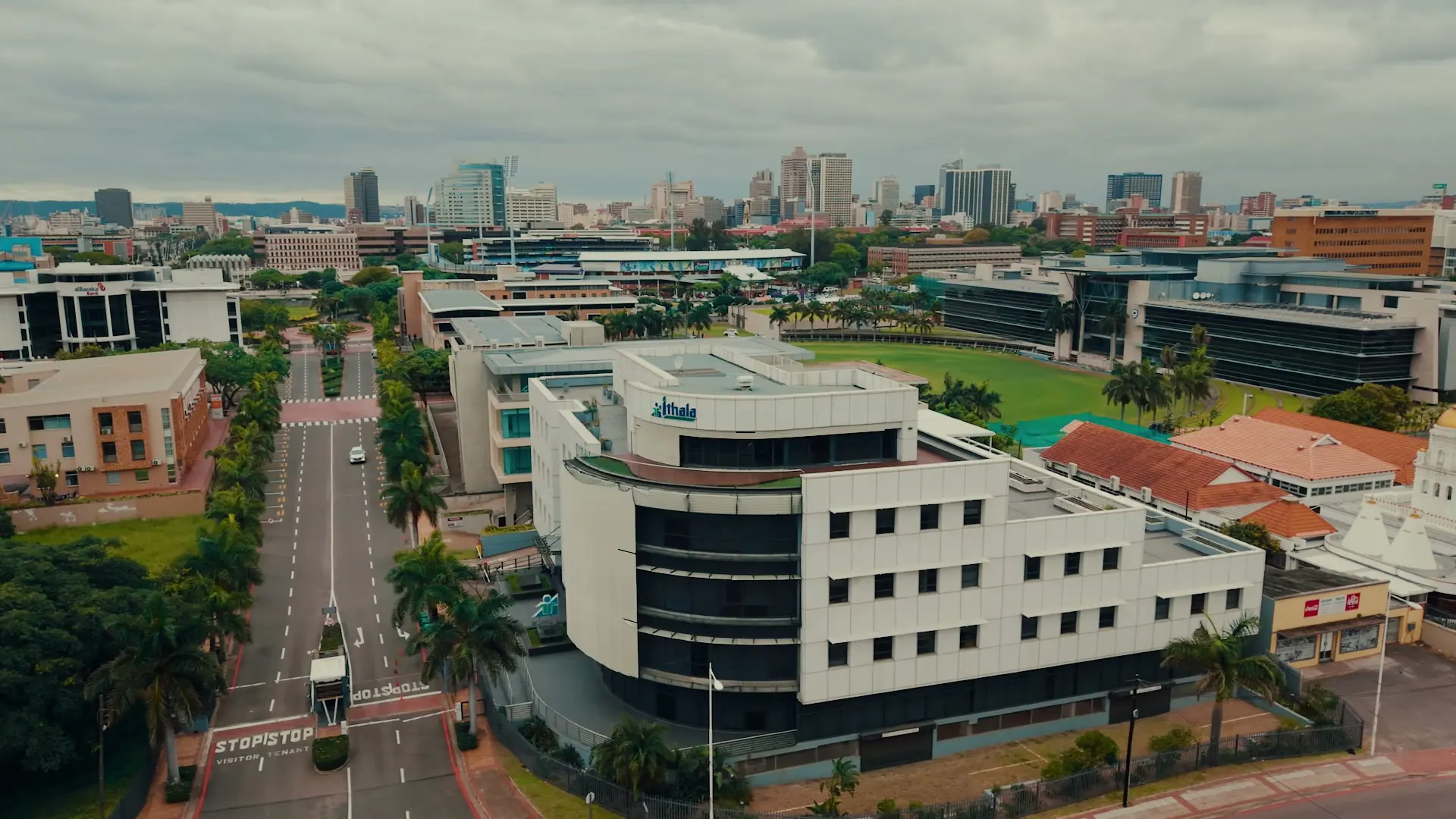
How to fly a roof inspection
A methodical flight gives you photos a roofer or an insurer can use.
Top-down first
One straight-down photo of the whole roof as a map for the report.
Then each face
Photograph each roof face at an angle, with overlap between frames.
Then the details
Zoom in on damage with the 3x telephoto, keeping a safe distance from the structure.
Shoot in RAW (DNG) so you can lift shadows under eaves and gutters later.
What a drone inspection is not
A drone gives a visual record. It does not replace a roofer walking the roof, a structural engineer’s assessment or survey-grade measurements, since the Air 3S has no RTK positioning. Our reading of SACAA’s public page is that inspecting a client’s roof for a fee is not private use. Check the requirements with SACAA. For building sites, see construction drone hire. For solar arrays, see solar panel inspection drone hire.
Before the flight decide what the photos must prove
Decide the purpose of the inspection first, because a photo set for an insurer differs from a set for a roofer's quote.
| Purpose | What the set must show | Who reads it |
|---|---|---|
| Insurance claim | Clear, dated photos of each damaged area, plus a wide photo that places each one on the roof | The insurer |
| Roofer's quote | Every roof face, plus close photos of each fault | The roofer |
| Buying a property | The whole roof, gutters and flashing, so you know what to ask about | The buyer and the conveyancer |
| Routine check | The same views each time, so you can compare them with last year | The owner or the managing agent |
| After a storm | Any lifted or missing sheeting, and debris in gutters | The owner |
Write the purpose at the top of your notes. If the photos are for an insurer, ask the insurer what they need before you fly, since the insurer decides what is accepted.
A numbering scheme that keeps photos usable
Number every roof face and every photo, so each fault can be found again.
- Draw a rough plan of the roof on paper and label each face with a letter, starting from the front of the house.
- Take the top-down photo first, and keep it open as your map.
- Photograph each face with the letter on your notes, in letter order, with overlap between frames.
- For each fault, take one wide photo that shows where it is, then one telephoto close-up.
- Rename files after the flight with the face letter and a number, for example B-03.
- Write a one-line caption for each fault, and sort them by roof face.
This takes a few minutes in the office and saves a phone call later. The roofer or the insurer then sees exactly where each fault sits.
Worked costs and what the hire covers
A single house roof fits the 2 hour hire at R4,000 excl. VAT, which is R4,600 incl. VAT.
| Job | Hire | Excl. VAT | Incl. VAT |
|---|---|---|---|
| One house roof | 2 hours | R4,000 | R4,600 |
| Several roofs, one managing agent | Half day, 4 hours | R8,000 | R9,200 |
| A large estate in one day | Full day, 8 hours | R16,000 | R18,400 |
| One roof with our operator flying | 2 hours hire plus 2 hours operator | R8,000 | R9,200 |
Every hire includes the DJI Air 3S, the RC 2 controller and three batteries. Our operator is available on request at R2,000 an hour excl. VAT, only when free on your date. You collect and return at 125 Bram Fischer Road, North Beach, between 08:30 and 16:30 on weekdays, and a late return costs R500 an hour.
What to do next with the photos you took
A photo set starts a repair conversation, and it does not end one.
- Send to the roofer
- Send the plan, the top-down photo and the fault photos together. A roofer can quote with more confidence, but will still check the roof in person.
- Send to the insurer
- Send dated photos and ask the insurer in writing whether they accept drone images. The insurer decides what it needs.
- Keep the originals
- File the untouched originals in a dated folder. Edits are for presentation, and the original is the record.
- Compare each year
- Fly the same views every year so the next set shows what has changed.
- Book a specialist
- Cracked walls, sagging beams and signs of water inside need a structural engineer.
Common mistakes and the limits of a drone check
A drone photo is a visual check, not a structural inspection and not proof that a roof is waterproof.
Flying too close
A drone near a roof edge risks the roof and the kit. Use the 3x telephoto and keep a safe distance.
Flying at midday
Hard shadows hide faults under eaves. Fly in softer light and check the footage on site.
No overall photo
A fault photo with no wide shot cannot be placed on the roof. Take the wide shot first.
Neighbours' property
SACAA's public page says keep 50 m from property without the owner's permission. Speak to the neighbours first.
Skipping the airport check
Our table puts Umhlanga Rocks about 5.6 km and the Gateway about 4.9 km from Virginia Airport. Check with SACAA if you are close.
Skipping the rules check
Our reading of SACAA's public page is that a paid inspection is not private use, so check SACAA's rules before you fly.
The Air 3S has no thermal camera, so it cannot detect moisture inside the roof. It also has no survey-grade positioning, so it cannot give measured quantities for a quote.
Which camera for which roof fault
Photograph the whole roof on the wide camera and each fault on the telephoto. DJI lists the medium tele camera at 70 mm equivalent against 24 mm for the wide one, so a tile or a ridge looks close to three times larger in the frame from the same spot.
| Fault | Camera | How to frame it |
|---|---|---|
| Lifted or slipped tiles | Wide, then telephoto | Wide photo of the roof face to place it, telephoto to show the gap under the tile |
| Rusted or missing screws | Telephoto | Fly level with the sheeting and frame one row of fixings at a time |
| Flashing gaps at a wall or skylight | Telephoto | Angle the camera along the joint so the gap shows as a dark line |
| Blocked gutters | Wide | A straight-down pass along the gutter line shows debris along its full length |
| Ponding on a flat roof | Wide | Top-down after rain, before the water dries off |
Both cameras take ordinary photos of what is visible. The telephoto gives you a closer view of a fault, not a size or a measurement, so leave measuring to the roofer.
Your roof or a client's roof: which rules you read
Who owns the roof and who gains from the photos decide which part of SACAA's public page you read. The questions below are our reading of that page, not a ruling, so check your case with SACAA.
- Whose roof is it?
SACAA's page describes private use as an individual's personal and private purposes with no commercial outcome, interest or gain. Our reading is that your own home, with nobody paying, sits closest to that.
- Is anyone paying?
A roofer quoting, an agent selling or a contractor charging a fee involves money or business gain. Our reading is that this points away from private use.
- Commercial needs more
Our reading of SACAA's public page: commercial operations need a registered UAS, a Remote Pilot Licence, a UAS Operating Certificate and a Letter of Authority. Drone laws in South Africa
- Not sure? Ask SACAA
A body corporate roof or a favour for a neighbour can sit between the two. Write to SACAA at rpasInbox@caa.co.za before you fly. We do not say whether a specific job is legal with our hire drone.
What a roof strike can cost you
Flying close to a roof puts the hire kit at risk, and the replacement values are higher than the R5,000 deposit. Use the telephoto instead of flying closer.
- Keep distance
- Hold the drone back from the roof edge, aerials and satellite dishes, and let the 3x telephoto do the close work.
- Watch the gusts
- Air can be gustier around a roof ridge. DJI rates the Air 3S for 12 m/s, but land well before that if the drone starts to drift near the structure.
- Mind the trees
- Overhanging branches near gutters catch propellers. Photograph those gutters from further out on the telephoto.
- Ask about cover
- Ask your insurer in writing whether your policy covers a hired drone. Commentary from insurance lawyers says many standard liability policies exclude damage arising from aircraft. Drone insurance in South Africa
Airport circles over Durban rooftops
By our straight-line figures, roofs in Umhlanga, around the Gateway and along the North Beach strip sit inside 10 km of Virginia Airport. Our reading of SACAA's public page is that you need SACAA approval to fly there, so check the address with SACAA before you book.
- 10 km from an aerodrome. Our reading of SACAA’s public page: do not fly 10 km or closer to an airport, helipad or airfield unless SACAA approves it.
- 50 m from people. Do not fly 50 m or closer to any person or group, a public road, or property without the owner’s permission.
Most houses front a public road, and our reading of SACAA's page puts public roads inside the 50 m rule along with people and property. On a narrow plot, plan the flight so the drone works over the back of the roof, away from the street, and check with SACAA if the road sits close to your roof. Where to fly a drone in Durban
A roof check from booking to deposit refund
Book a morning slot for the softer light, and keep the inspection inside the 2 hour minimum by sketching the roof before you collect.
- Paperwork and plan
Send your documents, sign the rental agreement, pay by EFT and sketch and letter the roof faces.
- Earliest collection
Count the kit with us at North Beach and check the charge on all three batteries.
- Fly the roof
Top-down map, each face, then telephoto close-ups of every fault.
- Copy and check
Copy the files off the 42 GB internal storage and look for gaps before you pack up.
- Latest return on any day
Return before your 2 hour block ends. A late return costs R500 an hour.
- Deposit back
We refund the R5,000 deposit after a satisfactory return.
Overnight or Friday? 8 hours can run overnight at the same rate: collect 15:00 to 16:30, return by 10:00 the next working day. On a Friday, or before a public holiday, the kit comes back by 10:00 on the next working day. Each weekend day or public holiday you fly costs R2,000 excl. VAT an hour of flight time, rounded up, with a 2 hour minimum, taken from your deposit at return.
- Hire excl. VAT
- R4,000
- Operator excl. VAT
- R0
- VAT at 15%
- R600
- Total incl. VAT
- R4,600
- Refundable deposit
- R5,000
- Paid by EFT before collection
- R9,600
Add your name so the invoice is made out to you.
The estimate is free to keep and compare. The pro forma invoice carries our banking details and a payment reference, so you can pay by EFT straight away. Your details stay in your browser; nothing is sent to us until you contact us.
Rates excl. VAT: R2,000 an hour, 2 hour minimum, R8,000 half day, R16,000 full day. Operator R2,000 an hour excl. VAT, only when free on your date. A full day can run overnight: collect between 15:00 and 16:30 on a weekday and return by 10:00 the next working day, for sunset and sunrise shots. Shorter hires come back the same day. On a Friday, or before a public holiday, the kit comes back by 10:00 on the next working day. Each weekend day or public holiday you fly costs R2,000 excl. VAT an hour of flight time, rounded up, with a 2 hour minimum, taken from your deposit at return. Your invoice is final, apart from flight time on weekend days or public holidays, which we charge at return. The deposit comes back within 7 business days of a satisfactory return.
Frequently asked questions about drone roof inspections
Still unsure? Ask us on WhatsApp or call 031 205 0210.
How much does a drone roof inspection cost in Durban?
Dry hire of the DJI Air 3S costs R4,000 excl. VAT for 2 hours, which suits a single roof. Your pilot flies it.
Can a drone find roof leaks?
It shows the visible causes, such as lifted tiles, gaps in flashing and blocked gutters. It does not detect moisture inside the roof; the Air 3S has no thermal camera.
Is a drone inspection accepted for insurance claims?
Ask your insurer. Clear, dated photos of the damage help most claims, but the insurer decides what it needs.
Can I inspect my own roof with a hired drone?
Yes, as private use over your own property, with no commercial gain. Keep 50 m from neighbours’ property unless they agree.
How should I prepare my photos for an insurance claim?
Take one wide photo that places each damaged area on the roof, then a close photo of each fault, with the date kept in the files. Keep the originals. Ask your insurer in writing what formats and images it accepts, because the insurer decides.
Can a drone show me the condition of my gutters?
Yes, visually. It shows blockages, sagging, rust and debris from above, and the telephoto camera lets you zoom in on the photo afterwards. It does not show what is inside the downpipe or behind the gutter.
How long does a roof inspection take?
That depends on the roof and your pilot, so we cannot give a fixed time. The hire minimum is 2 hours at R4,000 excl. VAT, which suits a single house roof. Fly the top-down photo first, then each face, then the details.
Can a drone tell me whether to repair or replace?
No. A drone photo is a visual check of the surface. It gives a roofer a record to work from, but the repair or replacement decision needs someone on the roof and, for structural doubt, an engineer.
Do I need to tell my neighbours before I fly?
Yes, ask first. SACAA's public page says do not fly 50 m or closer to any person or public road, or to property without the owner's permission. Tell neighbours, frame your own roof, and keep the camera off windows and gardens next door.
Which camera should I use for close-ups of roof damage?
Use the medium tele camera. DJI lists it at 48MP and 70 mm equivalent, close to three times tighter than the 24 mm wide camera, so you can stay further back from the roof for the same framing. Take a wide photo first so each close-up can be placed on the roof.
What happens if the drone hits the roof?
Land, check the kit and tell us. Repairable damage is charged at the repair cost plus a 15% administration fee. If the drone cannot be repaired, its replacement value is R34,000 excl. VAT. For damage to the roof itself, ask your own insurer in writing before the flight whether drone use is covered.
Can I inspect a body corporate roof with a hired drone?
Check with SACAA first. Our reading of SACAA's public page is that private use means personal purposes with no commercial outcome, interest or gain. A roof inspected for a body corporate or a managing agent may fall outside that, so ask SACAA at rpasInbox@caa.co.za before you fly.
Sources: SACAA Unmanned Aircraft Systems, DJI Air 3S specifications. Last reviewed 18 November 2026.