Drone laws in South Africa
The Part 101 rules that matter before you fly, in plain words.
The core rules every pilot follows
These come from SACAA’s Unmanned Aircraft Systems page, checked on 17 November 2026. Where a rule allows an exception, the exception needs SACAA approval or the owner’s permission.
- Line of sight
- Keep the drone in your own unaided sight at all times. A screen or goggles do not count.
- People
- No closer than 50 m to any person or group of people.
- Public roads
- No closer than 50 m to a public road.
- Property
- No closer than 50 m to any property, unless the owner gives permission.
- Airports and helipads
- Not within 10 km of an aerodrome, which includes airports, airfields and helipads, without approval.
- Height
- Not higher than 150 ft (about 46 m) above the ground, unless the Commissioner for Civil Aviation approves it.
- Restricted places
- Not next to or above nuclear power plants, prisons, police stations and other listed sites.
- Weather and light
- Fly in daylight and clear weather.
150 ft or 120 m? Why guides disagree
Many websites say you may fly up to 120 m (400 ft). SACAA’s own UAS page says 150 ft from the ground unless approved. The two figures describe different things.
150 ft
The general limit on SACAA’s public UAS page. Use it unless you hold an approval that says otherwise.
400 ft (120 m)
The ceiling in the definition of a visual line of sight operation, which approved operators can fly under their certificate.
Private flights
Private flying is restricted visual line of sight: within 500 m of the pilot and below the tallest obstacle within 300 m of the drone.
Private and commercial flying compared
SACAA’s approval table sets out what each kind of operation needs.
- Private
- Personal use with no commercial gain. No licence, operator certificate or registration listed. Drone under 7 kg. Only over property you own or have permission for.
- Commercial
- Air Service Licence, UAS Operating Certificate, RPAS Letter of Approval, Remote Pilot Licence and certificate of registration. See drone registration in South Africa.
- Corporate and non-profit
- Also need approvals and a licensed pilot. Check the exact list for your case with SACAA.
- Model aircraft
- Traditional model aircraft fall outside Part 101 and are handled by the South African Model Aircraft Association.
What this means in Durban
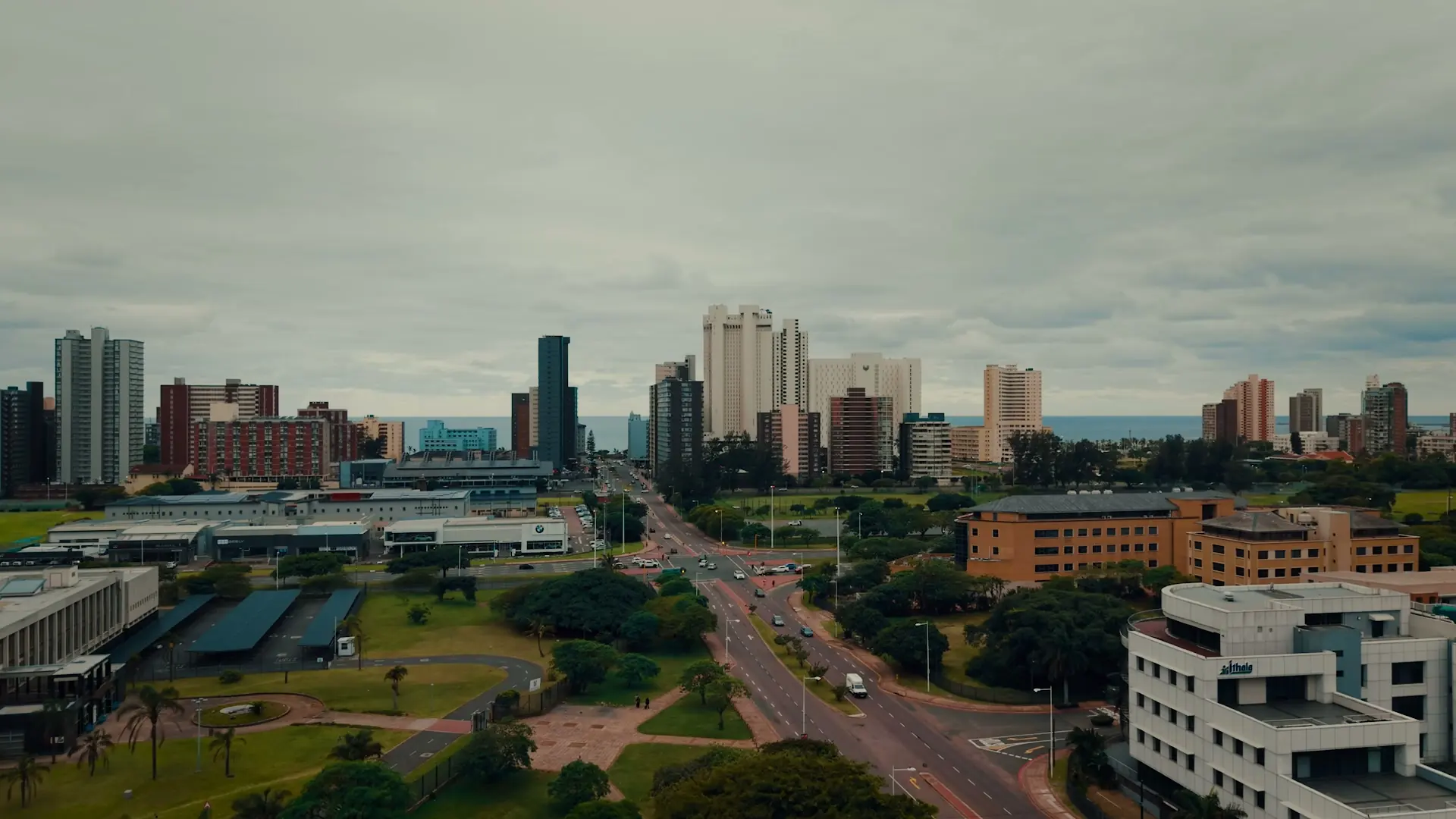
Durban has an airport inside the city. Virginia Airport in Durban North sits about 7 km from Moses Mabhida Stadium and about 9 km from North Beach, based on our straight-line measurement from map coordinates. So much of the central beachfront falls inside the 10 km aerodrome zone. Our where to fly a drone in Durban guide covers the airports, the harbour and the beaches.
Hiring a drone for a shoot? Our drone hire in Durban page sets out what you need before you collect.
Before every flight a six step rules check
Work through the same six checks each time you fly, because the rules depend on the place and the purpose of that flight.
- Decide the purpose. Private use has no commercial outcome, interest or gain. Anything else is treated differently.
- Find the nearest aerodrome, including airports, airfields and helipads, and measure the distance to your take-off point. Unless SACAA approves, stay more than 10 km away.
- Plan a path that keeps you more than 50 m from any person or group of persons and any public road.
- Get the owner's permission for any property closer than 50 m, including the land you take off from.
- For private flying, confirm you fly only within restricted visual line of sight with a Class 1A or 1B drone. For other flying, confirm the licence, registration and operator items.
- If any step is unclear, email SACAA at rpasInbox@caa.co.za and keep the reply.
Which rules apply to a private and a paid flight
The distance rules apply to every flight. The licence, registration and operator items depend on whether the flight is private.
| Rule or item | Private flight | Commercial, corporate or non-profit |
|---|---|---|
| 10 km from an aerodrome | Applies unless SACAA approves | Applies unless SACAA approves |
| 50 m from people, public roads and property | Applies, property needs the owner's permission | Applies, property needs the owner's permission |
| Remote Pilot Licence | Not required | Required |
| Certificate of registration | Not required | Required |
| UAS Operating Certificate and Letter of Authority | Nothing listed | Operator must hold both |
| Drone class and operation | Class 1A or 1B, restricted visual line of sight | Check your exact case with SACAA |
This table is our reading of SACAA's public page, not legal advice. SACAA's registration guideline also says no UAS may be operated unless registered, so confirm registration with SACAA. SACAA's page governs, so check any doubtful case with SACAA.
What the distances mean in practice
Both distance rules are measured from something you can point at, so you can check them on a map before you leave home.
10 km
SACAA's page says no flying 10 km or closer to an aerodrome, and it lists helipads as aerodromes. Check for helipads near your take-off point.
50 m
Stay more than 50 m from people and public roads, and from property unless the owner agrees.
Owner's permission
Permission covers property, not people or roads. Ask the owner of the land you take off from and fly over, and keep proof of the answer.
Common mistakes that break the drone laws
These are checks that are easy to miss.
- Measuring from the wrong point
- Measure from your take-off point to the aerodrome, and treat places near the 10 km line as uncertain. Our Durban distances are on the where-to-fly page. Where to fly a drone in Durban
- Forgetting helipads
- SACAA's rule names airports, helipads and airfields. Check for helipads near your take-off point.
- Ignoring roads
- SACAA's page names public roads in the 50 m rule, so plan the path around them.
- Treating owner's permission as optional
- The 50 m property rule has an exception only when the owner agrees. Ask before the day, not on arrival.
- Assuming a rented drone changes the rules
- The rules follow the flight and the pilot. Hiring from us does not change what you must check.
Exceptions and who can grant them
Most of SACAA's flying rules carry an exception, and each exception names who can grant it. The table below is our reading of SACAA's public UAS page, checked on 18 November 2026, so check your own case with SACAA.
| Rule on SACAA's page | Exception on the page | Who can grant it |
|---|---|---|
| Do not fly 10 km or closer to an aerodrome (airport, helipad, airfield) | Unless approved | SACAA |
| Do not fly higher than 150 ft from the ground | Unless approved | The Commissioner of Civil Aviation |
| Do not fly 50 m or closer to any property | With the owner's permission | The property owner |
| Do not fly 50 m or closer to any person or group of persons | None listed | No one, on our reading |
| Do not fly 50 m or closer to a public road | None listed in the private operations section | No one, on our reading |
| Do not fly in controlled, restricted or prohibited airspace | Unless approved | SACAA |
| Do not fly a drone weighing more than 7 kg | Unless approved | SACAA |
| Do not release, dispense, drop, deliver or deploy any object or substance | None listed in the private operations section | No one, on our reading |
The page lists no exception for the 50 m rules on people and public roads. Its examples of a group are sports fields, road races, stadiums, schools and social events. If your shot needs the drone closer than 50 m to people, ask SACAA at rpasInbox@caa.co.za before you plan anything else.
The same list also bars flying near manned aircraft, and adjacent to or above a nuclear power plant, prison, police station, crime scene, court of law, national key point or strategic installation, unless SACAA approves. A court or police station can sit in an ordinary street, so check the buildings around your take-off point as well as the airport distance.
One extra item separates commercial work from corporate work
SACAA's approvals table lists five items for a commercial operation and four for corporate or non-profit work. The difference is the Air Service Licence, which the table marks as required for commercial operations only.
Under the table, SACAA adds that an RPAS Maintenance Technician (RMT) is required for maintenance on RPAS classified as class 3 and higher. Whatever the class, the page also tells you to maintain the drone in line with the manufacturer's instructions and to inspect it before each flight. Drone licence in South Africa
How SACAA classifies a drone
SACAA classifies a drone by four parameters, and private flying is limited to Class 1A or 1B. Mass alone does not settle the class, so check yours against SACAA's documents.
- Mass
- The mass of the drone. Class 1A and 1B, the classes allowed for private flying, sit below 7 kg.
- Impact energy
- SACAA's page says the impact velocity has to be converted to an impact energy. Class 1A and 1B sit below 15 kJ. Appendix B of SACAA's Technical Guidance Material for Part 101 shows the method with an example.
- Height above ground
- How high the operation flies. The general limit on the page is 150 ft from the ground unless the Commissioner approves more.
- Flight rules
- The page lists four radio line-of-sight options: R-VLOS, VLOS, EVLOS and BVLOS. Private flying is R-VLOS only. Appendix C of the same guidance material illustrates each one.
Both DJI drones sit well below 7 kg, which settles mass and nothing else. Use the Appendix B method for impact energy, or send SACAA the drone model and ask which class it falls in, and keep the written reply with your flight records.
After a crash what SACAA expects you to report
Our reading of SACAA's public page is that a drone accident or incident must be reported, as prescribed in Part 12, when someone is injured or killed, property is damaged, or the drone is destroyed beyond economical repair. Check the process with SACAA.
- Make the area safe
Land the drone if you still control it, and keep people away from the drone and any broken parts.
- Record what happened
Write down the time, the place, who was flying and why. Photograph the scene and any damage before you move anything.
- Check if it is reportable
SACAA's page lists three triggers: injury or death, damage to property, and destruction of the drone beyond economical repair.
- Report it
Follow the Part 12 process. SACAA's page says its website lists investigators on standby to contact. Any incident where you lost control must also be reported to the holder of the UAS Operators Certificate.
- Tell the owner
If you hired the drone from us, call 031 205 0210 and bring the kit back to North Beach so we can check it with you. Drone rental terms in Durban
SACAA's page says an investigation sets out to establish the facts in the interest of aviation safety, and not to establish legal liability. Who pays for the damage is a separate question between you, your insurer and the person affected. Drone insurance in South Africa
Buying a drone and the notice the seller owes you
A seller must tell the buyer about the rules for flying a drone in South Africa. SACAA's page says this comes as a packaging label on a new drone, or as a written notice when a drone is resold, as set out in Document SA-CATS 101.
- Hobby flying
- SACAA's sample notice says operations as a hobbyist are subject to Part 94 of the Civil Aviation Regulations.
- Private use
- The same notice says private use is restricted under Part 101: personal purposes only, over property you own or have permission for, within 500 m of the pilot.
- Model aircraft
- Used only for air display, recreation, sport or competitions, and flown at approved SAMAA airfields only. Part 101 excludes them.
- Toy aircraft
- Designed or intended for use in play by children. Part 101 excludes them, yet the page names toy aircraft in its 50 m and 10 km rules.
- Any other use
- SACAA must first approve the drone by way of a UAS Letter of Authority, the drone must be registered before use, and the operator must hold a UASOC.
Buying second-hand? Ask the seller for the written notice. If the drone is registered, the seller completes form CA-47R2 and you complete form CA-47R1, and SACAA's page asks for both within 30 days of the sale, submitted together. Drone registration in South Africa
If you only fly model aircraft at a club field, SACAA's page points you elsewhere. The Commissioner of Civil Aviation has designated an external organisation, the South African Model Aircraft Association, to oversee recreational aviation, and SACAA refers model flyers to SAMAA for more information.
Your duties in the order they arise
SACAA's rules apply before, during and after the flight, so work through them in order. Each point below comes from SACAA's public page, in our reading of it.
- Read the seller's notice
Decide whether you will fly privately or for any commercial outcome, interest or gain.
- Check the site
Measure the distance to every aerodrome and ask property owners for permission in writing.
- Check the weather
SACAA's page says fly in daylight and clear weather conditions.
- Inspect the aircraft
The do's list asks you to inspect your aircraft before each flight.
- Keep it in sight
Stay within visual line of sight, at or below 150 ft unless approved, and away from manned aircraft.
- Report and record
Report any accident or incident the page lists, and keep your notes and photographs.
SACAA's page also says a pilot must observe all statutory requirements relating to liability, privacy and any other laws enforceable by other authorities. Those laws sit outside aviation, so a flight can keep every SACAA distance and still break another rule.
Liability
SACAA's page lists injury to the public and damage to people's property among the dangers of careless flying. Ask your insurer in writing whether your policy covers a drone before you fly. Drone insurance in South Africa
Privacy
The page names privacy by-laws as one source of legal liability. Point the camera at the subject you have permission to film, and keep neighbours, windows and private gardens out of frame.
Other authorities
A venue, a port or a municipality may set its own conditions. SACAA's page tells you to observe laws other authorities enforce, so ask whoever runs the place you plan to fly over.
Test a Durban site against the 10 km rule
Pick a place below to see how far it sits from Virginia Airport and King Shaka International. Our reading of SACAA's public page is that a flight 10 km or closer to an aerodrome needs SACAA approval, so check with SACAA before you plan the shoot.
Pick a place to see its distance from Virginia Airport and King Shaka International.
- 10 km from an aerodrome. Our reading of SACAA’s public page: do not fly 10 km or closer to an airport, helipad or airfield unless SACAA approves it.
- 50 m from people. Do not fly 50 m or closer to any person or group, a public road, or property without the owner’s permission.
The checker measures from each airport's reference point, and the real aerodrome boundary sits slightly closer. Helipads count as aerodromes too and are not in the checker. Our Durban guide groups every place by its margin to the line. Where to fly a drone in Durban
Frequently asked questions about drone laws
These answers summarise SACAA’s published rules. The regulations themselves govern, so check SACAA for your exact case.
What are the drone rules in South Africa?
Keep the drone in sight, stay 50 m from people, public roads and property without permission, stay 10 km from airports, airfields and helipads, and fly no higher than 150 ft unless approved. Fly in daylight and clear weather. Commercial flights need a licensed pilot and an approved operator.
How high can I fly a drone in South Africa?
SACAA’s UAS page sets 150 ft (about 46 m) above the ground unless the Commissioner approves more. Private flights must also stay below the tallest obstacle within 300 m of the drone.
How far from an airport must I fly a drone?
At least 10 km from any aerodrome, which includes airports, airfields and helipads, unless you have approval.
Can I fly a drone over people?
No. Stay at least 50 m from any person or group of people.
Can I fly a drone over my neighbour’s house?
Not without permission. Stay at least 50 m from property unless the owner allows it.
Can I fly a drone at night?
SACAA’s general guidance is to fly in daylight and clear weather. Its table for private flying mentions restricted line of sight by day and night, so check with SACAA before any night flight, and commercial operators check their certificate.
Do the laws apply to small drones?
Yes. Part 101 applies to drones of every size. Private flying is limited to drones under 7 kg.
Do the drone laws apply on private land I own?
SACAA's page lists these distances without a land-ownership exception. It does not say the rules stop on your own land, so ask SACAA. Only the 50 m property rule has an owner's permission exception. Check your case at rpasInbox@caa.co.za.
What counts as a private drone flight in South Africa?
SACAA's page describes private use as personal and private purposes where there is no commercial outcome, interest or gain. Private operations are restricted visual line of sight only, with a Class 1A or 1B UAS. Ask SACAA if your flight is borderline.
Can I get approval to fly closer than 10 km to an airport?
SACAA's page says you may not fly 10 km or closer to an aerodrome unless SACAA approves. It gives no fee or timeline for that approval in the part we checked. Email rpasInbox@caa.co.za and ask what they need.
Does the 50 m rule apply to cars?
SACAA's page names public roads, people or groups of persons and property. Stay more than 50 m from a public road. Plan the path so it never crosses one, and check the rule with SACAA if your site has private roads.
Can I hire a drone from you and fly it anywhere?
No. You must follow the same rules as any pilot. We hand over the drone, walk you through its safety guidelines, and you remain responsible for where and why you fly. We do not give legal advice, so check the rules with SACAA.
Do the drone rules apply to toy drones?
Our reading of SACAA's public page is yes for the distance rules. Part 101 excludes toy aircraft, but the page's do's and don'ts name toy aircraft in the 50 m rule, the 10 km aerodrome rule and the 150 ft height rule. Treat a toy drone near people, roads or airports with the same care, and check with SACAA.
Can I drop something from a drone in South Africa?
Not on a private flight, on our reading. SACAA's private operations section says do not release, dispense, drop, deliver or deploy any object or substance from a UAS. The page does not cover drops for other kinds of operation in that section, so an operator who needs one must ask SACAA at rpasInbox@caa.co.za.
Can I fly near a court or a crime scene?
Not unless SACAA approves, on our reading of its public page. The list of places names crime scenes, courts of law, national key points and strategic installations, along with nuclear power plants, prisons and police stations. It covers flying adjacent to these places as well as above them, so keep clear and check with SACAA.
Which drones fall outside Part 101?
SACAA's page lists autonomous unmanned aircraft, unmanned free balloons, aircraft operated in terms of Part 94, model aircraft and toy aircraft as excluded. Part 101 applies to commercial, corporate, non-profit and private operations. An exclusion from Part 101 does not mean no rules apply, so check your aircraft with SACAA.
When did South Africa's drone regulations start?
SACAA's page says Part 101, Remotely Piloted Aircraft Systems, came into operation on 1 July 2015. It arrived through the eighth amendment of the Civil Aviation Regulations, 2011, signed by the Minister of Transport. The Part 101 regulations and technical standards are on SACAA's Legislation page, and they take precedence over any summary, ours included.
Can I fly beyond visual line of sight?
Not on a private flight. Our reading of SACAA's page is that private flying is R-VLOS only. The page lists VLOS, EVLOS and BVLOS as other radio line-of-sight options and says operations are currently limited to radio line-of-sight. Any option beyond R-VLOS is a question for an operator to take up with SACAA.
Sources: SACAA Unmanned Aircraft Systems page. Last reviewed 18 November 2026.